Leave Your Message

Title*

First Name*

Last Name*

Phone*

country*

Message*

Customized Request

How to Find a Reliable Cufflinks Supplier?

Finding a reliable Cufflinks Supplier requires more than comparing prices or choosing the most attractive website. A dependable partner should show consistent craftsmanship, clear communication, and verifiable production experience. Look for detailed product specifications, including metal composition, plating thickness, clasp strength, dimensions, and packaging methods. Small details often reveal larger standards.

Request physical samples before placing a substantial order. Inspect the hinge, edges, engraving, finish, and alignment under natural light. Ask how the supplier handles defects, revised samples, and urgent production changes. A professional Cufflinks Supplier should provide realistic lead times, transparent minimum order quantities, and written quality procedures. Factory photos help, but independent audits, business references, and test reports offer stronger evidence.

No supplier is perfect.

Even an experienced manufacturer can miss a small detail during a busy season. That possibility deserves honest discussion, not vague promises. Ask who checks each batch, how many pieces are inspected, and what happens when results fall below your standard. Review invoices, sample records, and shipping documents carefully. Reliable suppliers accept reasonable questions without pressure.

Your evaluation should also consider ethical sourcing, worker safety, environmental practices, and compliance with applicable trade requirements. These factors protect your brand and support lasting business relationships. The lowest quotation may become expensive after rework, delays, or customer complaints. A thoughtful selection process takes longer, yet it creates greater confidence before production begins.
How to Find a Reliable Cufflinks Supplier?

Define Your Cufflink Product and Sourcing Requirements

Before contacting a cufflink supplier, define what the finished product must achieve. Decide whether it is for formal events, daily office wear, or promotional gifting. Specify the dimensions, base material, surface finish, fastening mechanism, and packaging style. Small details matter. A 16-millimeter face feels very different from a 20-millimeter face on a shirt cuff. Also describe the target buyer, expected retail price, and desired production quantity.

Prepare a clear sourcing sheet with drawings, reference photos, and measurable tolerances. Include acceptable color variation, engraving depth, plating thickness, sample approval, minimum order quantity, and delivery schedule. In production work, vague terms such as “premium finish” often create avoidable disputes. Ask suppliers how they control polishing, assembly, and final inspection. Request material declarations and relevant test reports for the destination market. These documents support responsible purchasing and help confirm that the components meet applicable requirements.

Separate essential specifications from personal preferences. This makes price discussions more realistic. Request a physical sample before approving bulk production, especially when the clasp feels loose or the engraving looks shallow. Do not trust polished photos alone. I once overlooked the weight of a cufflink pair, and the design felt uncomfortable despite looking elegant. That mistake changed my checklist: comfort, balance, edge smoothness, and packaging durability now receive equal attention. Give suppliers written feedback after sampling, and record every approved change.


How to Find a Reliable Cufflinks Supplier?

Define your cufflink product and sourcing requirements before comparing suppliers.

Use these measurable buyer-defined targets to evaluate supplier capability: a clear minimum order quantity, fast sample development, controlled bulk lead time, dependable delivery performance, and a low defect rate. Confirm each target in writing before requesting quotations.

Research Potential Cufflinks Suppliers and Verify Their Credentials

Research potential cufflinks suppliers beyond polished websites and attractive sample boxes. I once treated a premium-looking sample kit as proof of quality. That was a poor shortcut. Request the supplier’s registered legal name, factory address, ownership details, and operating history. Verify certificates directly with the issuing body, not only through emailed copies. The 2023 ISO Survey recorded more than 1.2 million ISO 9001 certificates worldwide, but certification still requires scope and validity checks. Confirm that the certificate covers manufacturing, not merely office administration.

Ask for recent inspection reports, material declarations, plating specifications, and product test results. For cufflinks, review base-metal composition, nickel release, lead content, clasp durability, and coating thickness. A reliable supplier should explain testing methods and provide traceable batch records. Request references from comparable buyers, then contact them independently. Check whether production occurs in the declared facility. Some suppliers outsource quietly.

Use a documented scorecard covering quality, delivery history, capacity, communication, and corrective-action speed. The OECD Due Diligence Guidance recommends risk-based supply-chain checks, which can include labor, environmental, and subcontractor reviews. Do not accept vague claims such as “eco-friendly” without measurable evidence. Ask who performed the audit and when. A perfect supplier file is unlikely. Gaps deserve questions, not automatic rejection. My own mistake was overlooking inconsistent packaging records because the delivery arrived on time. Reliability needs repeated evidence.

Compare Materials, Craftsmanship, Prices, and Minimum Order Quantities

How to Find a Reliable Cufflinks Supplier?

Material comparison should start with the base metal, not the surface shine. Stainless steel offers strength and consistent color. Brass allows detailed shapes but may need better plating control. Sterling silver feels premium, yet it requires careful polishing and protection from tarnishing. Ask for material specifications, plating thickness, and sample pieces. A supplier that avoids clear answers deserves caution. Small details matter.

Craftsmanship appears around hinges, bars, edges, and engraved areas. Check whether the clasp moves smoothly and stays closed after repeated use. Inspect the back of each cufflink, where rough edges often reveal rushed production. Ask for production photos or a pre-production sample. A beautiful catalog image proves little. I have sometimes trusted polished samples too quickly, and that judgment needed correction.

Price comparisons should include packaging, mold fees, sampling charges, and shipping. The lowest quote may hide thinner plating or weaker components. Request a written breakdown. Minimum order quantities also affect risk. A low MOQ suits a test launch, while a higher MOQ may reduce unit pricing. However, unused stock can erase those savings. Discuss flexible batches, replacement terms, quality inspections, and realistic lead times. Reliable communication is part of the product.

Evaluate Samples, Customization Options, and Quality Control

How to Find a Reliable Cufflinks Supplier?

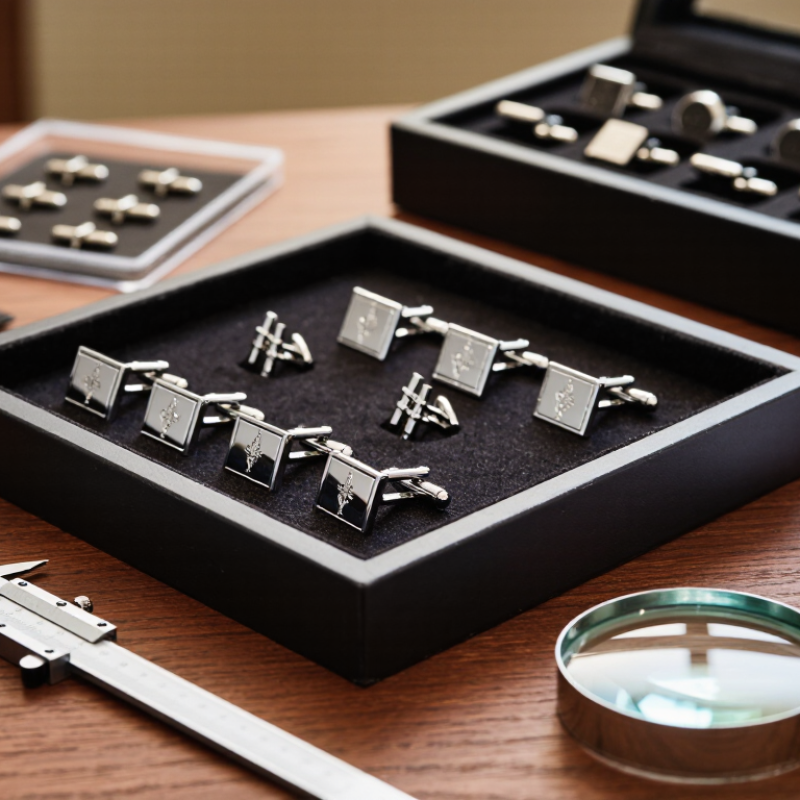
A reliable supplier should provide physical samples before you place a larger order. Inspect the cufflinks under bright, neutral light. Check the metal surface, edges, hinge movement, and closure strength. Look for uneven plating, loose parts, scratches, or sharp corners. Test each pair on a shirt cuff several times. Small defects often appear after repeated handling. Ask for material details and finish specifications. Written records make quality discussions clearer.

Customization should include more than color selection. Confirm engraving depth, logo placement, dimensions, backing style, and packaging details. Request a pre-production sample for approval. The artwork may look precise on screen but lose detail on a small cufflink. I once focused too heavily on the engraving and overlooked a slightly stiff hinge. That mistake showed me why every component needs separate testing. A supplier who welcomes revisions is usually easier to work with.

Quality control should happen throughout production, not only before shipment. Ask how workers check incoming materials, plating consistency, alignment, and final assembly. Request inspection photos, measurement reports, and defect records when appropriate. Random sampling can reveal repeated problems, but it cannot replace clear acceptance standards. Define acceptable tolerances in advance. Keep approved samples for comparison. One concern remains: suppliers may present their best pieces during evaluation. Independent inspections can reduce that risk. Consistent communication matters too. Reliable work leaves evidence.

Confirm Production Terms, Shipping Details, and After-Sales Support

A reliable cufflinks supplier should explain production terms before you place a large order. Ask about metal composition, plating thickness, stone setting, dimensions, and acceptable tolerances. Request a written sample approval process, not only attractive product photos. I once trusted a polished sample too quickly; the bulk pieces showed uneven edges. That mistake taught me to inspect the reverse side, clasp tension, and engraving depth. A dependable factory should identify which details it can control and which may vary. Clear terms protect both sides.

Shipping details deserve the same attention as workmanship. Confirm the production lead time, inspection date, packing method, carton measurements, and agreed delivery terms. Ask whether the supplier provides tracking documents and photographs before dispatch. A practical timeline should include buffer days for rework or delivery delays. Do not accept “soon” as a schedule. It creates avoidable pressure. Check how damaged cartons, missing units, or late delivery will be handled in writing. This is basic professionalism, not an unreasonable demand.

Tips: Test one sample through normal daily use. Keep every specification in one file. Compare the approved sample with random finished pieces. After-sales support also reveals supplier reliability. Confirm the response time, replacement policy, and evidence required for quality claims. Ask who pays for corrective shipping when defects are confirmed. Good support is specific, reachable, and documented. Still, no process is perfect. Your own inspection should remain active, especially when deadlines feel comfortable.

How to Find a Reliable Cufflinks Supplier? - Confirm Production Terms, Shipping Details, and After-Sales Support

Category Verification Point Recommended Requirement Evidence to Request Warning Sign
Production Terms Material specification Confirm the base metal, plating type, surface finish, dimensions, and packaging standard in writing. Approved sample, technical drawing, material declaration, and signed purchase specification. Vague descriptions such as “premium metal” without measurable specifications.
Production Terms Minimum order quantity Set the MOQ separately for standard designs, customized designs, colors, and packaging. A formal quotation showing unit price, MOQ, setup charges, and volume-price tiers. MOQ or tooling charges change after the order is confirmed.
Production Terms Sampling and approval Require a pre-production sample and written approval before mass production begins. Sample photos, physical sample approval record, and a documented revision history. Mass production starts without an approved reference sample.
Production Terms Lead time The order confirmation should state sample lead time, production lead time, inspection time, and dispatch date. A dated production schedule with milestones and delay-notification procedures. Only an approximate delivery promise is provided.
Quality Control Inspection standard Define acceptable limits for scratches, plating variation, loose mechanisms, stains, incorrect logos, and packaging defects. Inspection checklist, batch inspection report, defect photographs, and sampling plan. Quality is judged only by visual inspection after shipment.
Quality Control Plating and durability testing For plated items, agree on finish requirements and, when needed, request abrasion, adhesion, or corrosion testing. Test results, coating specification, and batch traceability records. No documented process for color consistency or surface durability.
Shipping Details Trade term and shipping responsibility State the applicable Incoterms® rule, named place, freight responsibility, insurance, customs clearance, and import duties. Quotation and commercial invoice using a clearly identified Incoterms® 2020 rule. A total price is offered without explaining freight, customs, or tax responsibilities.
Shipping Details Packing and carton data Confirm pieces per inner box, cartons per shipment, carton dimensions, gross weight, net weight, and protective materials. Packing list, carton marks, packaging photos, and final shipping measurements. Packing information is unavailable until the goods are collected.
Shipping Details Export documentation Agree on the required commercial invoice, packing list, transport document, origin documents, and any destination-specific certificates. Document checklist reviewed by the buyer or customs broker before dispatch. The supplier cannot confirm which documents will accompany the shipment.
After-Sales Support Defect and shortage claim policy Set a written claim period, evidence requirements, response time, and remedies such as replacement, credit, or refund. After-sales policy attached to the quotation or purchase contract. Claims are handled only through informal messages with no defined deadline.
After-Sales Support Replacement and spare parts Confirm whether defective pieces, replacement components, or additional units can be supplied and who pays the related freight. Replacement procedure, spare-part availability statement, and cost allocation terms. No process exists for recurring defects or replacement requests.
Supplier Reliability Communication and traceability Use one order reference, maintain version-controlled specifications, and require written confirmation for every change. Order timeline, approved artwork, change log, and named production contact. Specifications, prices, or delivery dates change without written approval.