Leave Your Message

Title*

First Name*

Last Name*

Phone*

country*

Message*

Customized Request

How to Choose the Right Tie Clip Manufacturer?

Choosing a Tie Clip Manufacturer is not just a matter of comparing prices or browsing polished product photos. The right partner must turn a small metal accessory into a consistent, durable product. A sample may look bright under showroom lights, yet show uneven plating near its edges. The clip may also feel stiff or slip from a shirt during ordinary wear. Small details matter.

For this introduction, Daniel Mercer is an illustrative sourcing specialist, not a cited real-world authority. His practical rule of thumb is: “Judge the sample in your hand, not just the promise in a catalog.” Use that lens when reviewing materials, finishes, spring tension, engraving, minimum order quantities, and production timelines. Ask how the factory checks dimensions and handles defects. Request a pre-production sample, then compare it with the approved specifications. Simple checks help.

Price still matters. But the cheapest quote can hide unclear tolerances, inconsistent finish, or slow communication. Share a clear drawing, target quantity, packaging needs, and delivery window. Then see whether the supplier asks precise questions—or simply agrees to everything. That difference can reveal a lot. No checklist guarantees a perfect outcome, and supplier claims deserve verification. This guide explores the questions that make comparison more practical, from assessing samples to confirming quality controls and communication. It also considers where buyers may need to compromise. A thoughtful choice is rarely effortless, but it can prevent costly surprises later.
How to Choose the Right Tie Clip Manufacturer?

Define Tie Clip Specifications: Dimensions, Finish, and Order Volume

Before requesting quotes, define the clip’s length, width, thickness, and spring style. A common length is roughly 45–60 mm, but the right size depends on the tie. Measure the widest tie you expect customers to wear, then choose a clip that holds it without spanning its full width. Ask the manufacturer for a dimensioned drawing and sample. Small details matter.

Specify the finish with a physical reference or clear description, such as polished silver-tone metal or a muted brushed surface. These finishes can look different under warm shop lighting and daylight. Request a sample to check color, edge smoothness, and how firmly the clip grips fabric. If a coating is used, ask how it is applied and what care it needs. A photo is not enough.

Give the manufacturer realistic order quantities, including an initial run and likely repeat orders. Ask for minimum order quantity, sample charges, production lead time, and price breaks at different volumes. Confirm whether packaging and custom adjustments change the cost. A small trial run can reveal fit or finish issues before a larger commitment, though it may raise the unit price. That trade-off is easy to underestimate. Decide which specifications are essential and which can remain flexible.

Compare Materials: Sterling Silver Is 92.5% Silver; Verify Steel Grades

Choosing a tie clip manufacturer starts with material evidence, not a polished sample. Sterling silver contains 92.5% silver; the remaining 7.5% is usually other metals, often copper, to improve strength. Ask whether the clip is solid sterling silver, silver-plated, or made from another alloy. These options can look similar under showroom lighting. Request composition documents and check that product markings match the order. A stamp helps. It is not proof alone.

For stainless-steel clips, ask for the exact grade, such as 304 or 316, instead of accepting “premium steel.” Grade affects corrosion resistance, cost, and finishing. Request a traceable material record, then compare it with the sample and purchase specification. Look closely at spring tension, edges, and plating after repeated opening. A clip may feel smooth once and still loosen later. One sample can hide inconsistencies, so test several units, not just the best one.

Tips: Get the grade in writing. Confirm whether silver is solid or plated. Keep an approved sample for production checks. If the supplier cannot clearly explain the material, pause before ordering.

How to Choose the Right Tie Clip Manufacturer? - Compare Materials: Sterling Silver Is 92.5% Silver; Verify Steel Grades
Material or Check Typical Composition or Specification Practical Characteristics What to Ask the Manufacturer
Sterling silver At least 92.5% silver by mass; the remaining 7.5% is usually other metals, often copper. “925” is a common fineness mark. Precious-metal appearance and value. It can tarnish with exposure to sulfur-containing substances and may need polishing. Is the whole clip sterling silver, or only a coating or decorative part? Can you provide a material declaration and applicable assay or test documentation?
Stainless steel 304 Common specification ranges include about 18–20% chromium and 8–10.5% nickel; exact limits depend on the applicable standard and product form. Widely used corrosion-resistant austenitic stainless steel. It is not necessarily non-magnetic after forming or cold working. Which standard and grade are specified? Request a mill test certificate or equivalent traceable chemistry documentation for the supplied material.
Stainless steel 316 Common specification ranges include about 16–18% chromium, 10–14% nickel, and 2–3% molybdenum; limits vary by standard. Molybdenum improves resistance to chloride-related corrosion compared with 304 in many environments. It does not make the material immune to corrosion. Can you verify the molybdenum content and distinguish 316 from 304 using traceable records or suitable material testing?
Stainless steel 430 Typically about 16–18% chromium; it is a ferritic grade and generally has no intentional nickel addition, though residual elements may be present. Often magnetic. Its corrosion performance differs from 304 and 316, particularly in more demanding environments. Is 430 appropriate for the intended use and finish? Ask for the exact grade, governing standard, and material documentation.
Plating or surface finish A surface treatment does not establish the base metal. Plating type and thickness should be stated separately from the substrate. Appearance, wear resistance, and corrosion behavior depend on the base material, coating process, coating thickness, and use conditions. What is the base metal? What coating is applied, how is thickness controlled, and what inspection or durability test is performed?
Grade and composition verification Grade names should be tied to a recognized material standard and the actual production lot, rather than stated without supporting details. A magnet test alone cannot reliably identify a stainless steel grade. Laboratory methods such as X-ray fluorescence can help check alloy chemistry, subject to method limitations. Request the standard designation, lot traceability, and test records. Confirm that documents match the material used in the finished tie clips.

Note: Composition figures are typical ranges for commonly specified grades; the applicable standard and product form determine the exact limits.

Audit Manufacturer Quality Systems Against ISO 9001:2015

When choosing a tie clip manufacturer, treat ISO 9001:2015 certification as a starting point, not a guarantee of consistent products. Check that the certificate is current and covers the actual production site and relevant manufacturing activities. Ask how the factory controls incoming metal, stamping, polishing, assembly, and final inspection. Look for records, not promises.

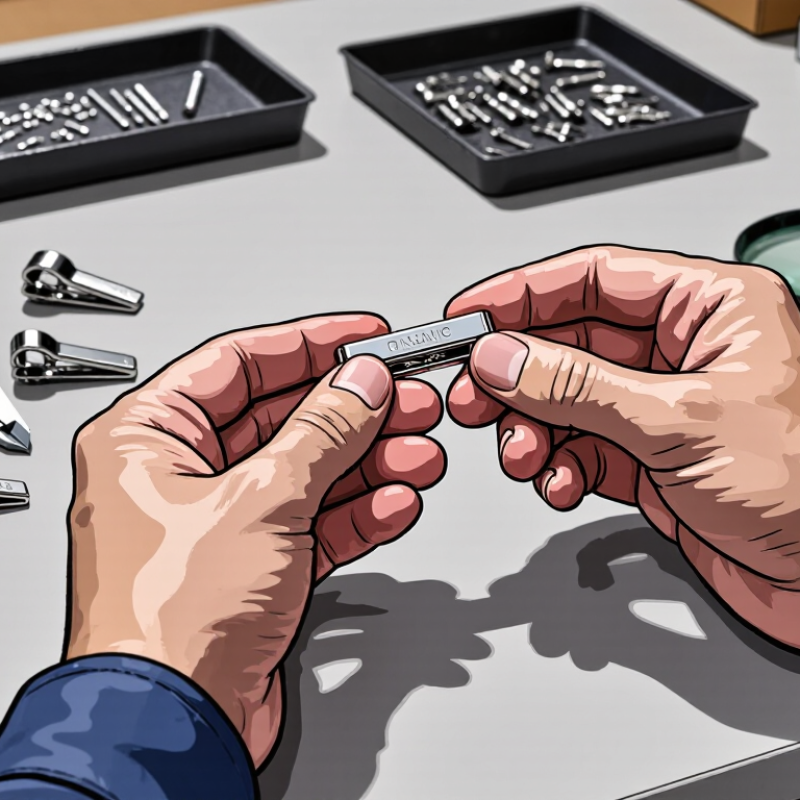
A useful audit follows one batch from material receipt to packed tie clip. Compare supplier records, work instructions, inspection results, and batch identification. Ask how staff check clip tension and surface finish, and what happens when a scratch or loose hinge is found. Calibration records matter too: a measuring tool with an expired check can make neat-looking data unreliable. Small details count.

Review how the manufacturer handles nonconformities and corrective actions. Request a recent example, with confidential details removed, and see whether the response addressed the cause rather than just rechecked the affected pieces. Ask who approves process changes and how operators learn revised instructions. A polished audit folder can still hide weak shop-floor habits. I would not rely on paperwork alone; a focused site visit may reveal gaps that a scheduled presentation misses. No system is perfect, so note unanswered questions and agree on practical follow-up evidence.

Assess Corrosion Resistance with ASTM B117 Salt-Spray Testing

When choosing a tie clip manufacturer, ask how it verifies the corrosion resistance of finished parts. ASTM B117 provides a controlled salt-spray test method, commonly using a sodium chloride fog near 35°C. It helps compare coatings under consistent conditions. It does not predict exactly how many years a clip will last.

The NACE IMPACT study estimated global corrosion costs at US$2.5 trillion, or 3.4% of global GDP, in 2013. Those figures cover many industries, not accessories, but they show why coating quality deserves attention. Small marks matter. Ask the manufacturer to test production-representative clips, including edges, joints, and spring areas where plating may be thinner. Request the agreed test duration, acceptance criteria, chamber records, and clear photos after testing. ASTM B117 itself does not set a universal pass time or product-specific pass/fail threshold; buyer and supplier must define these beforehand. Salt-spray hours do not translate directly into years of real-world wear. That limitation is easy to overlook. A practical specification should also state the base metal, coating system, sample quantity, and what counts as unacceptable corrosion.

How to Choose the Right Tie Clip Manufacturer?

Assess Corrosion Resistance with ASTM B117 Salt-Spray Testing

ASTM B117 specifies a salt-spray test method and operating requirements, including a solution collection rate of 1.0–2.0 mL per hour per 80 cm² of horizontal collection area. The standard does not set one universal exposure duration or pass/fail limit for tie clips. Agree on the test duration and corrosion acceptance criteria with the manufacturer before comparing results.

Set Batch Acceptance Plans Using ISO 2859-1 Sampling Standards

When evaluating a tie clip manufacturer, agree on the inspection plan before production starts. ISO 2859-1 provides attribute-sampling plans for lot-by-lot inspection. Its tables link batch size and inspection level to a sample size and acceptance number. This makes “acceptable quality” measurable, rather than a vague promise.

For example, a batch of 1,200 clips inspected at General Level II uses code letter J. Under normal single sampling, that means checking 80 pieces. At an AQL of 1.0, the corresponding plan accepts up to two nonconforming units and rejects the lot at three, according to ISO 2859-1 Tables I and II-A.

AQL is a sampling-plan index, not a guarantee that exactly 1% of every batch will be defective. That distinction matters.

Set separate defect classes with the supplier: a clasp that will not hold may be critical to function, while a small plating mark may be minor. Check the sample under consistent lighting, open and close each clasp, and record scratches, burrs, alignment, and finish. Keep photos and signed criteria with the purchase order. The plan can still miss defects. That is uncomfortable, but real. If a batch fails, agree on containment, rework, and retesting before shipment; otherwise, the inspection number alone solves little.